 CloudPhone
 Blog
Why a Taiwan-hosted cloud phone matters
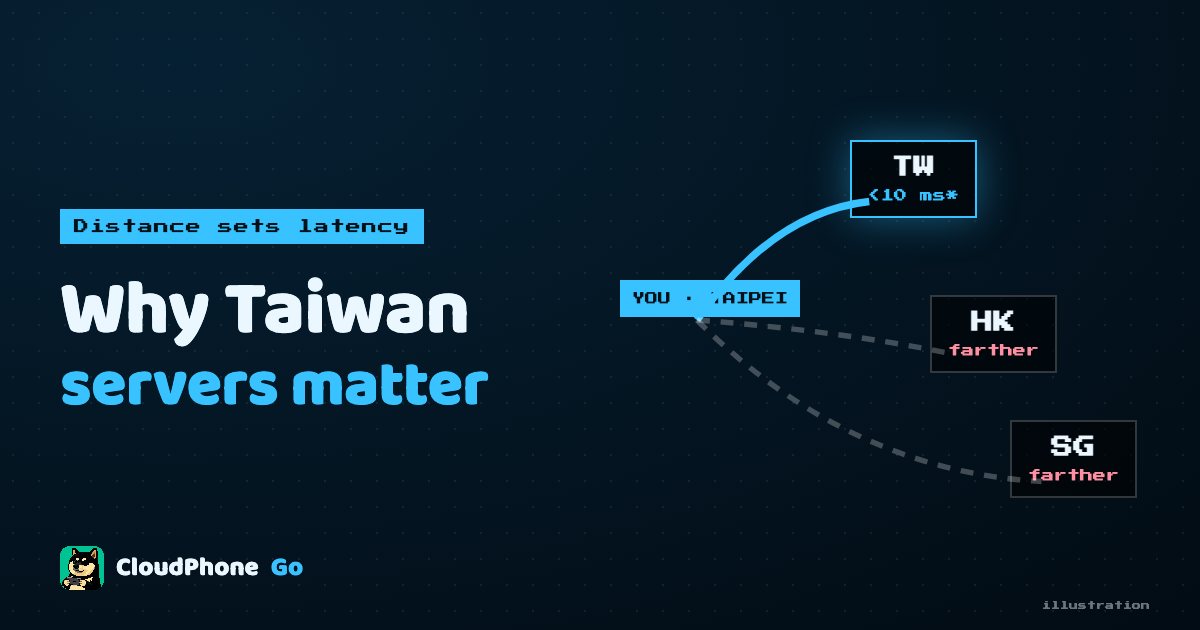
The same cloud phone plays very differently hosted in Taiwan versus Singapore. Here is why.
How much does a Taiwan-hosted cloud phone matter?
If you are in Taiwan, whether your cloud phone is hosted in Taiwan directly decides how responsive it feels. With a Taiwan host, every tap makes a short round trip within the island; with a host in Singapore or Hong Kong, every tap crosses an undersea cable and back. CloudPhone Go only runs devices in a Taiwan data centre, with a median latency under 10 ms in Taiwan (measured September 2026 from Taiwan fibre and 5G; it varies with your network).
When choosing a cloud phone, most people compare price and specs first. Server location tends to come last, and some services don't state it clearly at all. Yet the same cloud phone can feel completely different hosted in Taiwan versus overseas. This post explains what server location affects and how to check it yourself.
Why does distance decide latency?
Signals travel fast in fibre, but there is still a physical limit, and longer distances usually mean more routing hops along the way. Every extra hop and every stretch of undersea cable adds to the round trip. That is not something a better phone or a bigger plan can fix.
A cloud phone is not like streaming a video. A video can buffer, so a few hundred milliseconds go unnoticed. A cloud phone has to complete a full round trip for every tap before you see the result. So latency caused by distance turns directly into how the game feels.
- Idling and auto-combat: latency barely matters, because the game runs on its own in the data centre.
- Turn-based and card games: a little delay is usually acceptable.
- Orb puzzles, rhythm games and MOBAs: every input depends on reaction time, so small differences are noticeable.
What is the difference between a Taiwan host and an overseas host?
This compares the two from the point of view of a player in Taiwan. Overseas hosts vary by service and data centre location, so this lists only the differences you typically run into:
| Aspect | Taiwan host | Overseas host (e.g. Singapore, Hong Kong) |
|---|---|---|
| Distance from Taiwan | Round trip within the island | Crosses to another region and back |
| How controls feel | Lower latency, suits reaction-heavy games | Usually higher latency, action games more likely to feel late |
| Distance to Taiwan game servers | Short, so the cloud phone's game connection is short too | The cloud phone has to cross back to the game server |
| Support time zone | Same as yours | Depends on the service |
| Pricing | CloudPhone Go prices in New Taiwan dollars | Depends on the service, possibly foreign currency |
Many people assume idling doesn't care about latency, so location doesn't matter. The first half is true: your own latency doesn't affect idling. But the distance between the cloud phone and the game server still affects how stable the game connection is. More on that below.
What problem do Taiwanese players report most?
In 2021, aalloopp on the Bahamut Ragnarok Online board wrote that the Taiwan servers were full, so they could only pick Singapore, and the latency was pretty bad. Taiwan nodes filling up at peak times, forcing players onto overseas nodes, is one of the most common cloud phone complaints.
The trouble is that you subscribe thinking you have a Taiwan host and end up with overseas latency in practice. It is most likely when a new game launches or a big update lands and everyone rushes for Taiwan nodes at the same time.
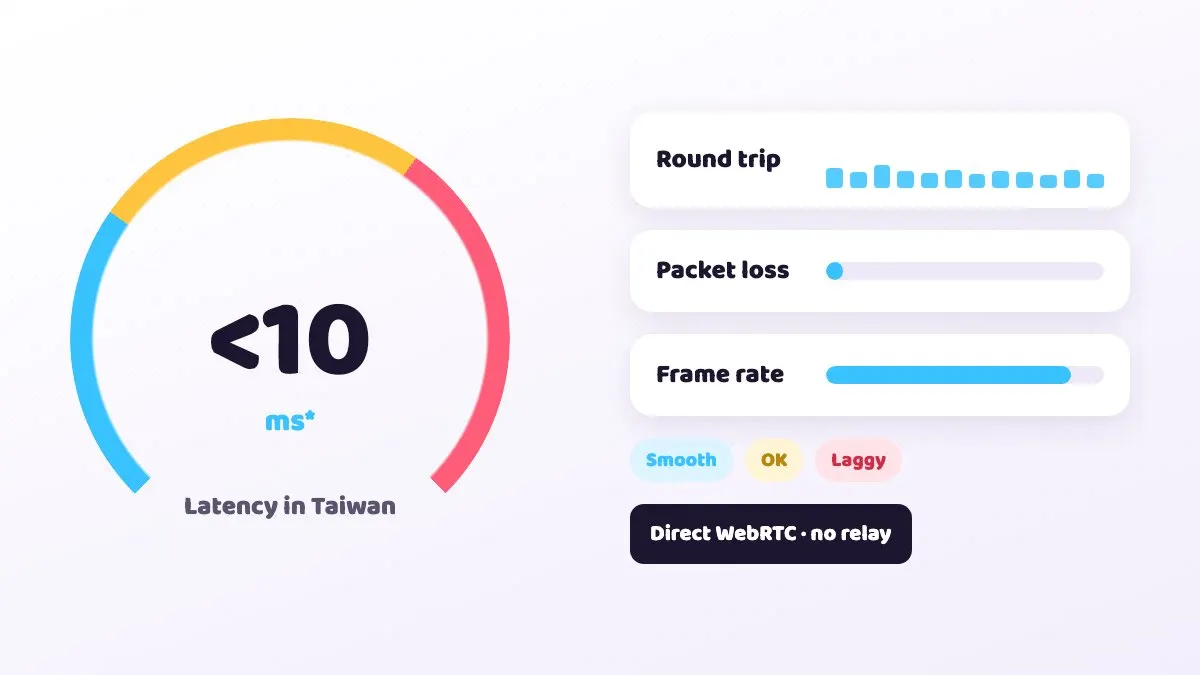
CloudPhone Go is based in Taiwan, and today every cloud phone runs in our Taiwan data centre. We plan to open data centres in Japan and other regions over time, so players in each region can connect to a host near them; if you are in Taiwan, you use the Taiwan data centre. You can see the RTT for yourself in the connection quality indicator.
Why does it matter that game servers are in Taiwan too?
Playing on a cloud phone involves two connections: you to the cloud phone, and the cloud phone to the game server. Most people only think about the first and forget the second.
Popular Taiwan mobile games such as Lineage M and Arena of Valor mostly run servers in or near Taiwan. If the cloud phone is in Taiwan too, the second leg is also short, the game connection is steadier, and idling is less likely to drop because of network jitter. If the cloud phone is overseas, even an idle session has to cross the sea to reach the game, which is more fragile when international links are congested.
- Taiwan cloud phone plus Taiwan game server: both legs short, better feel and stability.
- Overseas cloud phone plus Taiwan game server: both legs cross the sea, and the latency stacks up.
- It depends on the game: some games host servers in Japan, Hong Kong or elsewhere, so check where yours is.
What does a local Taiwan team change?
With both the servers and the team in Taiwan, there are a few practical benefits:
- Chinese-language support in your time zone, so you are not waiting for someone else's office hours.
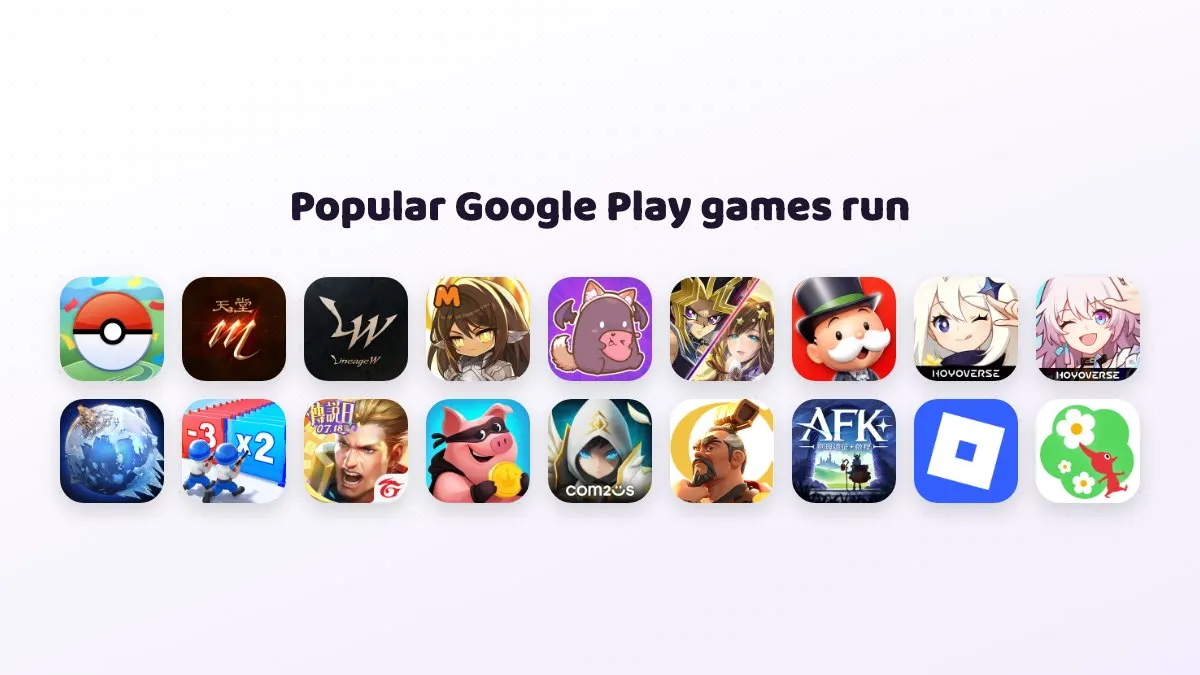
- Popular Taiwan games are tested first, such as Lineage M and MapleStory, titles Taiwan players have been playing for years.
- Prices in New Taiwan dollars with Stripe checkout. During Beta, Starter billed yearly averages NT$419 a month. Pricing is based on NT$9 per CPU core per day, and after discounts it goes as low as about NT$6.20 per core per day.
- Google sign-in with no passwords stored. The billing page shows your renewal date and invoices and lets you cancel renewal.
胖胖, one of the team, has been gaming for 20 years and using cloud phones for more than 10, and his favourites are Pokémon GO and MapleStory. His reason for building CloudPhone Go was simple: overseas cloud phones lagged so badly from Taiwan that he couldn't even idle Lineage M with peace of mind. A Taiwan data centre was a requirement from the start, not an add-on.
When does server location matter less?
To be fair, not everyone needs a Taiwan host. If any of these apply, location matters a lot less:
- You live outside Taiwan long term: a data centre near you will give better control feel.
- The games you play run servers outside Taiwan, for example only Japanese or US servers.
- You only idle, barely touch the controls, and the game isn't sensitive to network jitter.
But if you are in Taiwan, play on Taiwan servers and sometimes want to jump in yourself for bosses or quests, the difference a Taiwan host makes is obvious.
How can you check that a cloud phone is really in Taiwan?
- Check whether the website or plan details clearly state the data centre location. 'Asia node' does not mean Taiwan.
- Connect to the cloud phone from your usual Taiwan network and open the connection quality indicator to see RTT.
- Test at different times of day, especially evening peak hours, to see whether latency rises noticeably.
- Watch for messages like 'node full, please choose another region', which suggest you may be placed overseas.
- Open the game you play most and see whether the in-game ping is stable.
- If there is a free trial, test with it before paying.
CloudPhone Go offers a free 12-hour trial card. Email hello@cloudphonego.com for a redeem code and test with your own network and games.
Common misconceptions about Taiwan servers
- 'Just use a VPN to Taiwan.' A VPN only changes your route; it doesn't move the cloud phone to Taiwan. Corporate VPNs and strict firewalls can also block direct WebRTC.
- 'Overseas hosts are cheaper, so they are better value.' If the latency stops you playing anything interactive, or idles keep dropping, the savings may not be worth it.
- 'Idling doesn't need low latency, so location doesn't matter.' Your control latency doesn't affect idling, but the distance from the cloud phone to the game server still affects stability.
- 'A Taiwan host means zero latency.' A Taiwan host shortens the distance, but your own Wi-Fi or mobile signal still affects the feel. With a weak signal, latency still goes up.
- 'I will get the same latency from abroad.' The host is in Taiwan, so the further you are, the higher the latency. Idling is unaffected, but reaction-heavy games will feel slower.
FAQ
Q: Are all CloudPhone Go servers in Taiwan? A: CloudPhone Go is based in Taiwan, and today all cloud phones run in the Taiwan data centre. We plan to add data centres in Japan and other regions to give local players lower latency.
Q: What does a Taiwan host have to do with my game? A: Servers for popular Taiwan mobile games are mostly in or near Taiwan. With the cloud phone in Taiwan too, its connection to the game server is short and steadier. It depends on the game.
Q: Can I use it from overseas? A: Yes, through a browser, but the further you are from Taiwan, the higher your latency. The idle itself runs in the data centre and is unaffected.
Q: Can Taiwan servers fill up? A: Every service has finite capacity. The Taiwan data centre is our main base and grows with demand; regions like Japan are planned to serve players there, not as overflow for Taiwan users.
Q: How do I know my latency? A: The cloud phone's connection quality indicator shows RTT, packet loss and FPS live. Connect from your usual network and take a look.